
Hyderabad’s growing water crisis has pushed the Hyderabad Metropolitan Water Supply & Sewerage Board (HMWSSB) to rethink its strategies. With demand for water tankers skyrocketing and complaints piling up, the board has turned to Artificial Intelligence (AI) for answers. This is not a tech experiment for headlines, it’s a survival tactic for thousands of families who wait, count, and hope for the next water tanker. AI is now not only crunching numbers but also telling stories about neighborhoods struggling for water, exposing patterns of tanker bookings, and pointing out localities where borewells have failed.
More importantly, it is helping the board plan better, and for residents like those in Pragathi Nagar, it could be the start of a more predictable water supply.
Why AI Became a Necessity in Hyderabad Water Management?
The demand for water in Hyderabad is not uniform. Some colonies receive municipal water once a week, while others wait months. To tackle this imbalance, HMWSSB deployed AI to:
- Track tanker booking patterns across neighborhoods.
- Analyze complaint history, identifying areas with recurring issues.
- Highlight abnormal consumption trends in large complexes.
For instance, Sahiti Residency in Pragathi Nagar booked 674 tankers in 2024 alone, an insight that was invisible without AI. The board realized such demand hotspots require permanent solutions, not just stop-gap measures. AI essentially became a compass, guiding officials toward fairness and efficiency, ensuring water supply decisions are rooted in evidence rather than guesswork.
Pragathi Nagar: A Case Study of Dependence
If there’s a neighborhood that symbolizes Hyderabad’s water woes, it is Pragathi Nagar. Residents here narrate their daily struggles with a sense of fatigue:
- Failed borewells: The rocky terrain means underground water is almost impossible to access.
- Limited municipal supply: Earlier, water was supplied once in 15 days. Today, it comes just two days in two months.
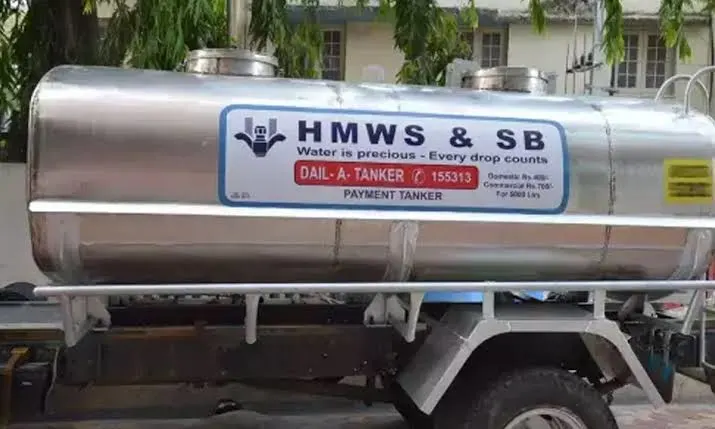
- Rising tanker dependence: With more than 100 housing complexes, families survive solely on water tankers.
These stories reveal the human side of tanker statistics. A mother describing how she juggles cooking schedules around tanker timings, or an elderly resident climbing stairs with buckets, adds urgency beyond the numbers. AI detected the crisis, but the people live it every single day.
Role of Technology in Tackling Urban Water Challenges
The introduction of AI in studying tanker demand is only the beginning of how technology can reshape water management in cities. Beyond predicting tanker requirements, advanced systems can monitor groundwater levels, detect leaks in pipelines, and even forecast seasonal shortages with climate data. By integrating AI with IoT sensors and GIS mapping, water boards can create a real-time dashboard of the city’s water health.
This not only prevents emergencies but also allows better allocation of resources where they are most needed. For Hyderabad, where certain areas suffer chronic shortages, technology can become a bridge between data and action. It ensures that citizens’ complaints are not lost in paperwork but become inputs for smarter solutions. Ultimately, technology is not replacing human decision-making but enhancing it, giving civic bodies the precision they need to manage a complex and growing city.
What the AI Study Revealed About Citywide Patterns?
The AI-powered system did more than identify top tanker users. It unearthed broader truths:
- Seasonal peaks: Summer sees a sharp surge in tanker bookings, especially in high-rise colonies.
- Complaint concentration: A handful of neighborhoods generate the bulk of water shortage complaints.
- Repetitive issues: Some areas repeatedly face the same distribution lapses, showing systemic flaws.
This layered analysis is a breakthrough. Instead of firefighting scattered complaints, HMWSSB can now pre-empt shortages. For residents, it could mean fewer anxious calls to helplines and more predictable delivery. For the city, it means moving from reactive crisis handling to proactive planning.
Government’s Immediate Action Plans:
When HMWSSB Managing Director Ashok Reddy visited Pragathi Nagar, residents poured out their frustrations about tanker dependence and irregular supply. Within hours, a ₹3 crore feeder main project was approved to stabilize water distribution in the area. This quick decision reflects how AI insights are being converted into tangible action. Beyond Pragathi Nagar, the Water Board is considering several additional measures to tackle the city’s growing water demand:
- Expanding AI Deployment – The board plans to extend AI usage beyond tanker bookings, using it to forecast demand during peak summer months and anticipate shortages before they occur.
- New Feeder Lines in Stress Zones – Areas like Pragathi Nagar are not alone in facing scarcity. Dedicated feeder lines are being planned for other high-stress neighborhoods to ensure a consistent supply.
- Complaint Pattern Analysis – By studying recurring complaints with AI, officials can prioritize areas suffering the worst shortages, ensuring no community is repeatedly neglected.
- Faster Redressal Mechanisms – The board is exploring AI-powered dashboards to track unresolved issues in real time, allowing field teams to respond faster.
- Investments in Infrastructure – The ₹3 crore feeder project is just the beginning; more funds are expected to be directed toward pipelines, treatment plants, and storage reservoirs.
- Engagement with Residents – Senior officials have started holding direct meetings with local communities, turning AI findings into human conversations that guide decisions.
- Long-Term Water Planning – Beyond immediate fixes, AI data will be used for future city planning, helping design sustainable supply systems that can keep pace with Hyderabad’s rapid growth.
This marks a clear shift in governance. Policies are no longer based on assumptions or delayed reports but on real-time, data-backed urgency that responds directly to people’s needs.
Residents’ Expectations and Emotional Toll:
While the AI rollout brings optimism, residents’ expectations remain deeply personal. They don’t talk in percentages but in lived realities:
- A family is missing school because water tankers arrived late.
- Apartments are pooling money to buy emergency tankers at inflated costs.
- Calls for an alternate-day supply that would restore dignity to daily life.
These accounts highlight why AI-driven projects must translate into visible change at the household level. For citizens, data and dashboards mean little unless they feel water flowing regularly in their taps.
Future Outlook: Building Sustainable Water Systems with AI
While AI is currently being used to study tanker demand, its future role could be far more transformative. The data generated today can form the foundation for long-term water planning, including designing new reservoirs, optimizing distribution networks, and planning urban expansion with water availability in mind. By learning consumption habits and shortage patterns, AI can even recommend alternative solutions such as rainwater harvesting projects or decentralized water treatment plants.
For Hyderabad, this means moving beyond short-term fixes like tanker supply toward a sustainable, self-reliant system. If the city succeeds in embedding AI into its water policies, it could serve as a model for other Indian metros facing similar challenges. The real success of this initiative will be seen not in tanker numbers, but in households that no longer need to depend on them.
AI as a Long-Term Solution to Urban Water Stress:
The introduction of AI is not a magic wand, but it represents a turning point. Hyderabad, like many Indian cities, is racing against growing populations, climate fluctuations, and infrastructure gaps. By adopting AI, HMWSSB is:
- Creating demand forecasts for more efficient resource allocation.
- Improving transparency, since complaints and tanker bookings are mapped clearly.
- Encouraging accountability, as repetitive issues can no longer be ignored.
If implemented consistently, this AI-based approach can become a model for other cities where tanker mafias thrive, borewells dry up, and residents live with uncertainty.
Conclusion:
Hyderabad’s water story has always been about scarcity, but the narrative is shifting. With AI, the Water Board is no longer just reacting; it is predicting, planning, and investing in long-term solutions. For families in localities like Pragathi Nagar, this means hope that they will not have to fight for every bucket. The technology-human partnership AI reading patterns, people voicing needs, and officials acting is the only way forward for a thirsty city. If the experiment works, Hyderabad could set an example for water-stressed metros across India.
FAQs:
AI helps analyze booking patterns, identify high-demand areas, and predict shortages, making water management more efficient and data-driven.
Pragathi Nagar topped the list, with Sahiti Residency alone booking 674 tankers in 2024 due to failed borewells and poor supply.
The Water Board approved a ₹3 crore feeder main project to stabilize supply and reduce dependence on tankers.
By analyzing recurring complaints and hotspots, AI helps the board prioritize responses and address systemic issues instead of isolated cases.
AI cannot create water, but it can guide smarter distribution, improve planning, and reduce inequities, making it a vital long-term tool.